
Shopping Cart

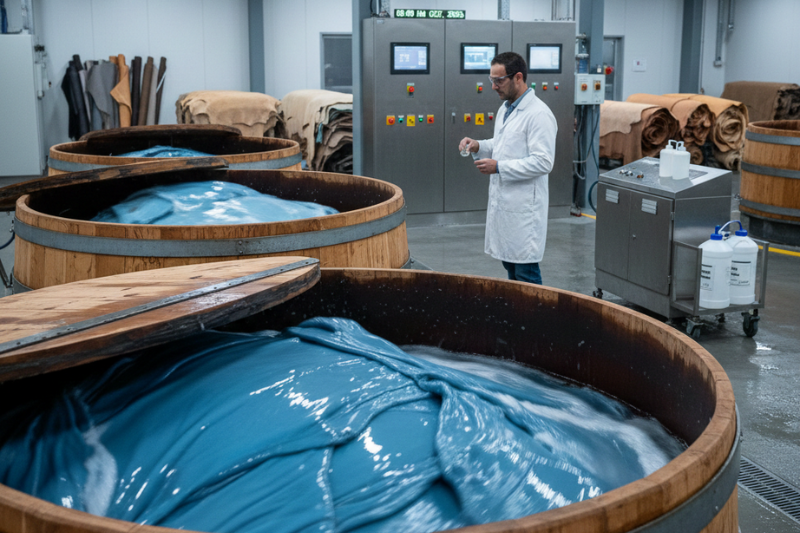
Chrome-tanned leather is one of the most widely used materials in the leather industry thanks to its resistance, flexibility, and manufacturing speed. In this article, we explain in detail what chrome tanning is, how the process works step by step, its advantages and disadvantages, and how to obtain quality leather without compromising the environment.
Chrome tanning is a chemical process of transforming animal hide into leather using trivalent chromium salts (Cr III). This method replaces unstable proteins in the skin with stable chemical bonds, preventing rot and giving the leather greater durability.
It is used on a massive scale because it allows for chrome-tanned hides to be obtained in just a few hours, compared to the days or weeks required for vegetable tanning. Additionally, it produces softer, more elastic leathers that are resistant to water and heat.
Comparing both methods helps to understand when it is best to use each one:
Among the advantages of chrome tanning, speed, uniformity, and softness stand out. As a disadvantage, it requires strict chemical control to minimize its environmental impact.
The chrome tanning process consists of several well-defined technical stages. Each one is key to achieving stable, high-quality leather:
Includes soaking, liming, and deliming. In this phase, organic remains, hair, and fat are removed, and the fibrous structure of the skin is prepared to absorb the tanning agent.
The skin undergoes an acid bath with salts to lower the pH. This facilitates the homogeneous penetration of chromium into the collagen fiber.
Chromium salts (Cr III) are added, which react chemically with the collagen fibers. This is where the true transformation from skin to leather occurs.
The pH is raised in a controlled manner to fix the chromium within the leather structure, achieving thermal and chemical stability.
These phases adjust the feel, color, and elasticity of the leather, allowing for specific finishes according to its final use.
The success of chrome tanning depends on precise control of variables such as:
Poor control can lead to brittle leathers, stains, or the release of unfixed chromium.
The environmental impact of chrome tanning depends on waste management. Modern tanneries use bath recycling systems, water purification, and chromium recovery, drastically reducing their ecological footprint.
When performed correctly, chrome-tanned leather can be compatible with responsible practices.
It is important to distinguish between:
A well-controlled process prevents the oxidation of Cr III to Cr VI.
Working with specialized suppliers is key. At Curtidos Cabezas you can find selected chrome-tanned hides for crafts and leatherwork, such as:
Choosing well-tanned leather not only improves the final result but also guarantees safety, durability, and respect for the process.
If you are looking for reliable chrome-tanned leather for your projects, at Curtidos Cabezas we advise you so that you choose the right skin according to your work and level of demand.


Comments (0)