
Shopping Cart
- Cueros
- 2 likes
- 38203 views
- 0 comments
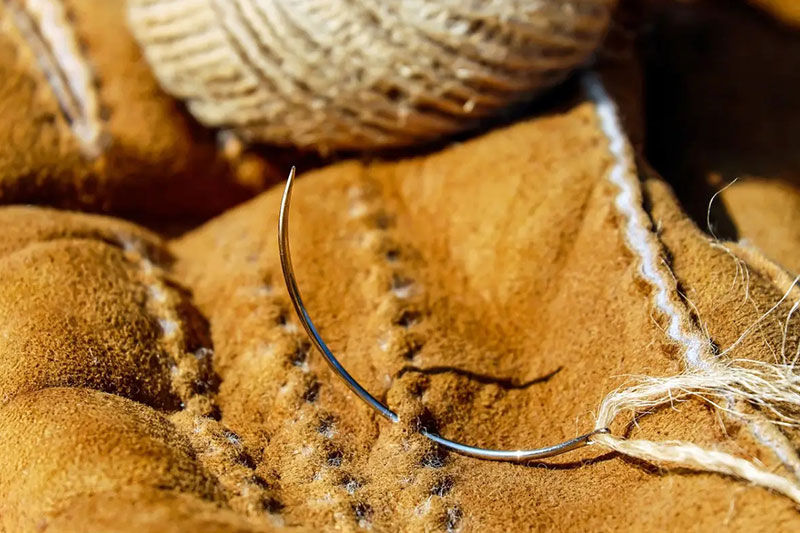
To work leather the traditional way, you need to know certain hand leather stitching techniques and specific tools that help you achieve durable, high-quality results.
Leather is a noble, resistant material used to make bags, shoes, belts, wallets, cases and much more. So it’s normal to ask: what techniques exist, and how can you do them professionally with the best finishes? At Curtidos Cabezas, we’ll walk you through everything.
What is leather and how is it worked?
Leather is tanned animal hide, treated to prevent decomposition and improve its properties. It can come from different animals such as cows, goats, sheep, pigs, and more—each with its own thickness, texture, color and strength.
Leather can be grouped into three types depending on the layer used: grain (outer, finer layer), flesh side (inner, thicker layer), and split leather (intermediate, more flexible layer).
Before stitching, you’ll usually follow several steps: cutting, gluing, marking and punching. These depend on the project type and your design.
What types of hand leather stitching techniques are there?
There are different hand-stitching techniques for leather, each with pros and cons depending on the result you want. Some of the most common are:
<
Single stitch
One of the most basic. You simply pass the thread through the holes, alternating sides. Use one needle and stitch from one end to the other. It’s fast and easy, but not very strong or decorative unless you want a rustic look.
Saddle stitch (double stitch)
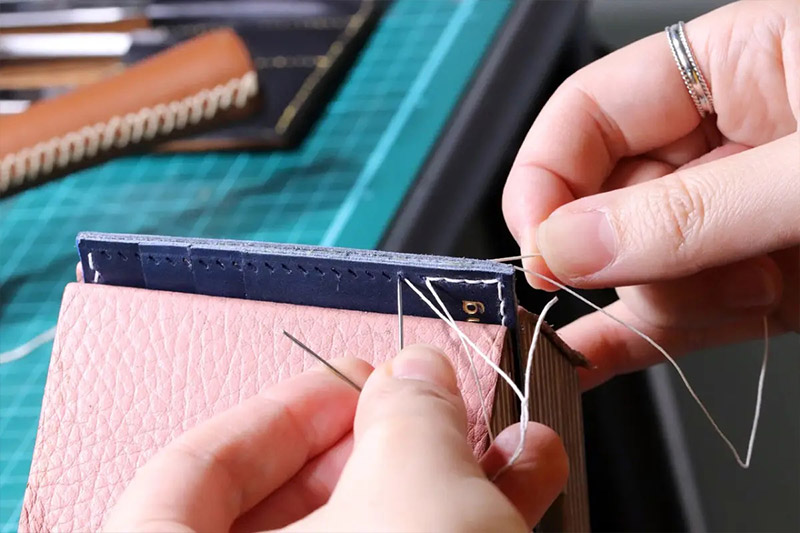
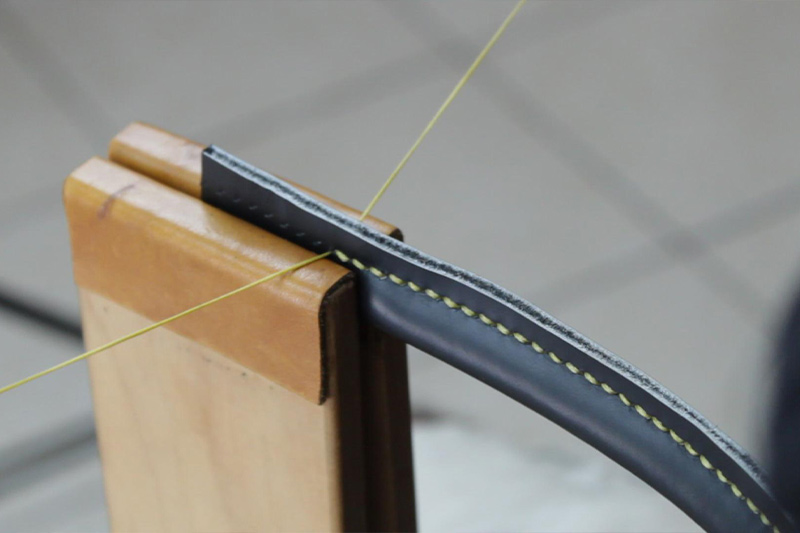
One of the most used: you pass two threads through the same holes, crossing them. Use two needles and often start in the middle and work toward the ends. It’s strong and beautiful, but takes more time and skill.
Wrap stitch
A variation of the saddle stitch where the threads wrap around the leather edge. Two needles, from one end to the other. Decorative and it protects the edge, but it uses more thread and is harder to do well.
Spanish stitch
Another saddle-stitch variation where the threads form a right angle to the edge. Two needles, from one end to the other. It looks elegant and gives a “padded” appearance, but it’s more complex and requires precision.
What tools do you need to hand-stitch leather?
Beyond solid hand leather stitching techniques, you’ll also need essential leatherworking tools that make the job easier and help ensure a great result. The must-haves are:
Needles
They carry the thread through the leather holes. They should be steel, with a large eye so the thread passes easily, and long/thick enough not to bend or snap while stitching.
There are different needle tips: round point, triangular point, diamond point, etc.
Thread
It joins the leather pieces. It must be strong and matched to the leather thickness. There are different thread types such as waxed cotton, nylon or polyester.
Awl
Used to punch holes in the leather for the thread to pass through. It has a sharp point and a wood or metal handle. You can use it with a mallet or by hand depending on leather thickness and the force needed.
Punch
Another tool that helps punch circular holes. It has a metal head with different diameters and a wood or metal handle. Use it with a mallet and a firm, clean strike.
Wing divider / scratch compass
Used to mark the stitch line on the leather. It has two metal arms with sharp points and a nut to set the spacing. Slide one arm along the leather edge and the other across the surface to leave a visible line.
Groover
Also used to mark the stitch line, but by cutting a groove into the surface. It has an adjustable blade and a guide to set the distance from the edge.
The guide slides along the edge and the blade lightly removes a thin layer, leaving a groove.
What’s the difference between hand stitching and machine stitching?
They’re two different ways to stitch leather, each with pros and cons:
Hand stitching takes more time and patience, but gives you more control and precision. Machine stitching is faster and more comfortable, but depends on machine quality and setup.
With hand techniques, you can achieve creative and personalized results. Machine stitching is more uniform and limited by the machine’s stitch type and configuration.
Hand stitching is often more durable, because the threads cross and form a “knot” in every hole. Machine stitching can be weaker and easier to break, since threads don’t lock the same way.
Finally, hand techniques aim for an aesthetic, artisanal finish. Machine stitching is more associated with industrial production and mass manufacturing.
Why choose hand stitching?
Hand stitching is ideal if you want to work leather with your own hands and enjoy the creative process. It offers advantages such as:
- A firm, strong and long-lasting seam that won’t come undone over time.
- It highlights the natural beauty of leather and creates an elegant, unique look that’s hard to match with a machine.
- A personal challenge and a chance to learn skills—the satisfaction of making something by hand is hard to beat.
Choose the best leather tools at Curtidos Cabezas
If you’ve chosen hand stitching, you’ll want the best tools to make the process easier and the result cleaner. At Curtidos Cabezas you’ll find all the leather tools and materials you need to work hide with quality and professionalism.
Curtidos Cabezas is a family business with 50+ years of experience in the leather sector, offering a wide range of products and services that will help you take on new challenges and refine the finishes you love.
Comments (0)