
Shopping Cart


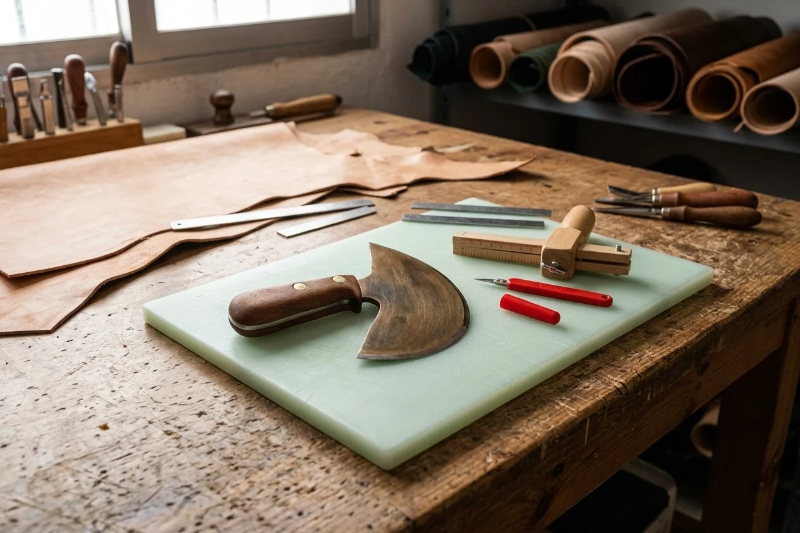
Cutting leather cleanly, precisely, and safely is the fundamental pillar supporting any leathercraft, saddlery, or leather art project. A poorly executed cut not only ruins the aesthetic appearance of a piece, but it can also cause costly material waste and alignment errors during the stitching phase. Whether you are working with fine goat skins, splits, or thick veg-tan leather for belts, mastering the different cutting tools and techniques will allow you to transition from an amateur finish to a fully professional one.
Each type of leather and each cutting style require a specific tool. Using the correct instrument reduces physical effort, prevents premature wear of the cutting edges, and guarantees clean lines on the first pass. In our section of tools for cutting and punching leather, you will find the ideal equipment for any level of experience.
These are the most versatile tools in the workshop, especially recommended for beginners in leathercraft or for tasks requiring intricate patterns and tight curves. A good utility knife or a manual utility cutter equipped with sharp, replaceable blades will make it easier to handle corners, interior cutouts, and small pieces for cardholders or wallets.
The head knife (also known as a half-moon knife or saddler's knife) is the iconic tool of traditional leather craftsmanship. Its fan-like design distributes hand force evenly, allowing for straight cuts, bevels, edge skiving, and smooth curved paths without the blade biting into the leather. If you are looking for maximum precision and top-tier professional quality, the Vergez Blanchard half-moon cutting knife is an investment for life.
DIY vs. Professional Solutions: It is common to try using household scissors or office utility knives when starting out. However, ordinary scissors crush the leather fibers, leaving a frayed and irregular edge, while school utility knives lack the necessary rigidity and can dangerously veer off course. Using professional leathercraft tools guarantees a flat, polished edge ready for dyeing or edge finishing.
A good cut depends 50% on the blade and 50% on the supporting surface and alignment guides. Working without proper protection reduces precision and destroys tool edges within minutes.
To achieve flawless straight lines, it is essential to have a rigid guide that will not deform or be nicked by the blade. We always recommend using a stainless steel metal ruler, ideal for its weight, durability, and exact millimeter graduation.
You should never cut leather directly on a soft wooden table or hard plastic surface. To protect your workspace and cushion the blade edge, we offer heavy-duty professional solutions such as the Vergez Blanchard high-density Ertalon pounding block and the essential self-healing standard cutting mat.
A golden rule in the workshop: a dull tool is much more dangerous than a sharp one, as it requires excessive muscular force, leading to a loss of control over the stroke and a risk of slipping over the material.
Cutting long, parallel strips freehand with a ruler can be frustrating, as the leather tends to stretch or shift during the process.
What leather thickness is easiest to cut for beginners?
To take your first steps and get familiar with cutting tools, it is best to practice with medium-thickness leather (between 1.2 mm and 2.0 mm). We recommend starting with our economical assortment in the leather scraps by weight section, a fantastic option for practicing techniques and building confidence without fear of ruining large, expensive pieces.
Why does the leather bite or tear when cutting?
This happens for two main reasons: a blade that is not sharp enough, or trying to cut through the entire thickness of the leather in a single pass with excessive pressure. The secret to a polished edge is making multiple light passes while always following the same guide line.
In what direction should the leather be cut?
You should always cut by keeping the blade at a slight forward-leaning angle and making the stroke toward your body or from left to right (if you are right-handed), keeping your free hand safely protected behind the guide ruler.
Equip your workshop with the best tools on the market! We invite you to visit our online store at Curtidos Cabezas to find all the materials, hides, and accessories you need.
```


Comments (0)